
AI governance in lending is no longer a compliance afterthought. It is the specific thing India’s central bank is now asking every regulated lender to prove it has, in board minutes and audit trails, not just in a policy document nobody has read since it was signed off.
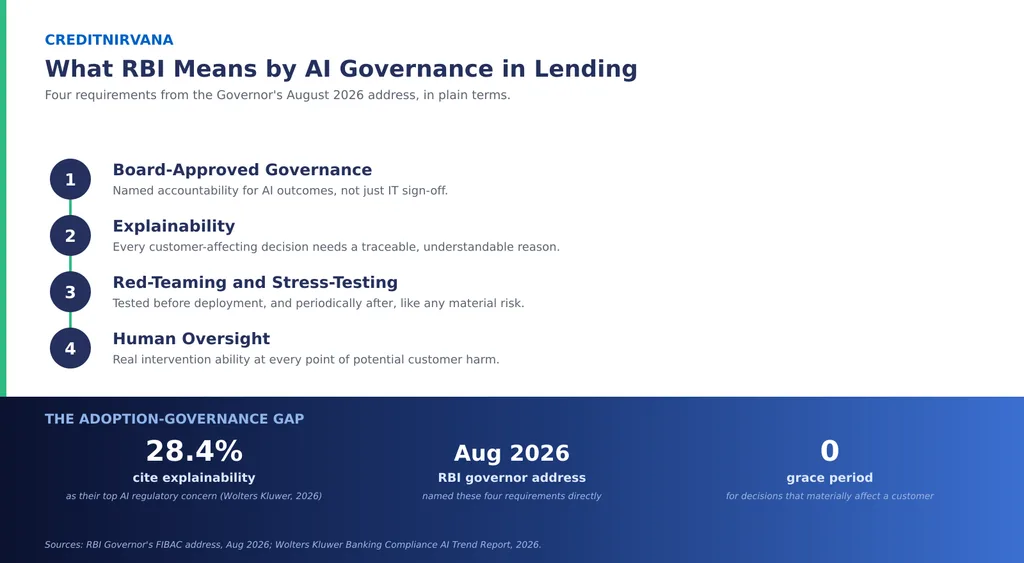
In August 2026, RBI Governor Sanjay Malhotra laid out what AI governance in lending actually requires in terms this direct: board-approved AI governance policies, clear accountability for outcomes rather than just technology procurement, the capacity to explain AI-driven decisions that materially affect a customer, and meaningful human oversight at every point where an AI system’s error could cause real harm. That is not a light checklist. It is a description of exactly the gap most lending organisations currently have between how fast they’ve adopted AI and how well they’ve governed it.
Why the Gap Exists in the First Place
AI adoption in banking has moved fast because the upside is obvious and immediate. A 2026 Wolters Kluwer Banking Compliance AI Trend Report found that explainability and transparency, cited by 28.4 percent of financial institutions, and bias and discrimination risk are now the two most acute regulatory concerns tied to AI in lending. Those are not new risks. They are the same risks credit scoring has always carried. What has changed is the scale and speed at which an ungoverned AI model can now make, or influence, a lending decision.
Governance has moved slower for a structural reason, not a lazy one. Governance requires cross-functional coordination between risk, compliance, technology, and business teams that adoption simply does not. A single team can deploy a new AI model quickly. Building board-level accountability, explainability standards, and red-teaming discipline around that model requires the whole organisation to move together, and that always takes longer than the technology itself does.
What RBI Is Actually Asking For
Governor Malhotra’s framing deserves to be read closely, because it is more specific than most regulatory guidance on AI has been so far. Four requirements stand out.
Board-approved governance, not IT sign-off. AI governance in lending has to sit at board level, with named accountability for outcomes, not delegated entirely to a technology team’s internal review process.
Explainability for decisions that affect a customer. If an AI system contributes to a lending decision, credit approval, pricing, or a recovery action, the institution needs to be able to explain why, in terms a regulator or an affected customer could actually follow, not just in terms of model architecture.
Red-teaming and stress-testing before and after deployment. AI systems need the same adversarial testing discipline applied to any other material risk in the institution, tested before launch and periodically afterward, not once at go-live and never again.
Human oversight at points of material harm. Meaningful human oversight has to exist specifically where an AI system’s error could cause real harm to a customer or to financial stability, not as a general disclaimer that “a human is in the loop” somewhere in the process.
None of these four requirements ask a lender to slow AI adoption down. They ask for the governance layer to catch up to where adoption already is.
Where This Shows Up Most in Collections
Collections is one of the sharpest edges of this issue, because it sits exactly where Governor Malhotra’s third and fourth points, red-teaming and human oversight, matter most directly to a real person’s financial life.
An AI system deciding which account gets a settlement offer, which gets escalated, and which gets a legal notice is making decisions that materially affect a customer, in Malhotra’s own framing. If that system cannot explain why one borrower received a repayment plan and another received escalation, the institution has an AI governance in lending gap sitting inside its own recovery operations, not a theoretical risk somewhere upstream in credit underwriting.
What Closes the Gap in Practice
Closing an AI governance in lending gap is not primarily a policy-writing exercise. It has to be built into how the AI system itself operates, or the policy stays theoretical.
Every AI-driven action needs a logged, auditable reason behind it, not just a logged outcome. A system that can show a regulator the specific signal, propensity score, payment history, sentiment, that triggered a specific recovery action is demonstrating explainability in the way Malhotra described it, not just claiming it. This is the exact discipline CreditNirvana’s Maestro engine is built around: every one of its 150-plus GenAI collection agents operates inside a compliance-checked, fully audited process, with immutable, version-tracked logs behind every decision, not a black box that produces an outcome without a traceable reason.
Human oversight needs to be structural, not incidental. A workflow builder that lets a supervisor see exactly what every AI agent is doing in real time, with the ability to intervene, is meaningful human oversight in the sense Malhotra described. A dashboard reviewed occasionally after the fact is not.
And governance needs board visibility, not just technical documentation. If a Collections Head can present, in board-level terms, exactly how AI decisions in recovery are made, explained, and overseen, that closes the specific gap RBI has now named directly, rather than leaving it as an assumption the institution hopes holds up under scrutiny.
The Cost of Waiting to Build This
There is a temptation to treat AI governance in lending as something to formalise once a regulator asks for it directly. That sequencing rarely works out well in practice. Governance built retroactively, after an AI system is already embedded in daily collections operations, means retrofitting explainability into decisions that were never designed to be explained, and reconstructing audit trails for actions that were never logged with that purpose in mind.
The institutions that will find this transition easiest are the ones where explainability and audit logging were part of the AI system’s design from day one, not bolted on after the fact. That is a genuinely different, and considerably cheaper, starting point than trying to reverse-engineer governance into a system that has been running unexamined for a year or two already.
Frequently Asked Questions
What is AI governance in lending? AI governance in lending refers to the framework of board-level accountability, explainability, testing, and human oversight that a financial institution applies to any AI system involved in lending or recovery decisions. It is distinct from AI adoption, which is simply using the technology, and governance is what makes that use accountable and auditable.
What did RBI say about AI governance in 2026? In August 2026, RBI Governor Sanjay Malhotra outlined specific expectations for AI governance in lending: board-approved governance policies, explainability for decisions that materially affect customers, regular red-teaming and stress-testing of AI systems, and meaningful human oversight at points where an AI error could cause real harm.
Why does AI governance matter specifically in collections? Collections AI systems make decisions, who gets a settlement offer, who gets escalated, who receives a legal notice, that directly and materially affect a borrower. Under RBI’s own framing, these are exactly the kind of decisions that require explainability and human oversight, making collections one of the highest-stakes areas for AI governance inside a lending institution.
How can a lender demonstrate AI governance to a regulator? By showing, not just claiming, that every AI-driven decision has a traceable, auditable reason behind it, that human supervisors have real-time visibility and intervention ability over AI-led processes, and that governance decisions are made and reviewed at board level rather than left entirely to a technology team.