
For most of the last five years, the growth story in Indian NBFC lending was unsecured credit. Personal loans, consumer durable loans, and small-ticket digital credit grew far faster than the system average, and NBFCs led that growth. That story is changing in front of us, and the change is visible in the data, not just in analyst commentary. NBFCs are rotating back toward secured lending, and the reason is simple: unsecured growth outran the underwriting discipline needed to support it, and the bill came due.
For a Collections Head, this is not an abstract market trend to note and move past. It is a direct signal about what kind of recovery capability the organisation needs over the next few years, and it is different from what most teams have spent the last five years building.
What the Data Actually Shows
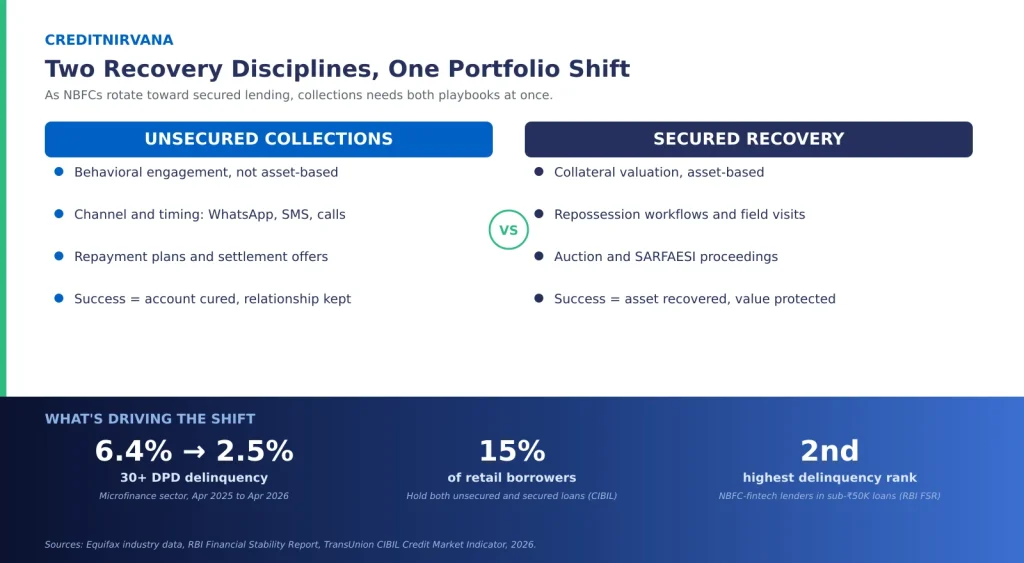
The signals have been building for a while, and they are no longer subtle. Equifax’s most recent industry data shows the 30-plus days past due delinquency rate in microfinance falling from 6.4 percent in April 2025 to 2.5 percent in April 2026, a sharp correction that reflects tighter underwriting across the sector, not a coincidence. At the same time, Equirus Research has documented a clear pivot among NBFCs toward secured products, sharper risk-adjusted pricing, and a gradual shift toward individual lending among lenders that previously leaned heavily on microfinance-style group exposure.
The stress that triggered this correction was concentrated exactly where growth had been fastest. Nomura’s analysis flagged rising delinquencies specifically in small-ticket personal loans under fifty thousand rupees and in loans originated through fintech partnerships, the same segments that had driven the bulk of incremental NBFC growth. RBI’s own Financial Stability Report went further, stating plainly that NBFC-fintech lenders carry the second-highest delinquency levels in the small-loan category, trailing only small finance banks. This was not a fringe concern. It was a central bank naming a structural weak point in its own stability assessment.
Perhaps most tellingly, TransUnion CIBIL has flagged something that should worry any lender running a mixed portfolio: delinquency stress in unsecured, consumption-led loans is already spreading into secured lending. Their analysis of 37 million borrowers holding both loan types, 15 percent of all retail borrowers, found that unsecured delinquency reliably precedes secured-loan delinquency in the same borrower relationship. Unsecured stress is not staying contained. It is a leading indicator for what happens next in a lender’s secured book, which is exactly why underwriting and collections teams cannot treat the two portfolios as unrelated problems.
Why NBFCs Are Rotating Toward Secured Lending
The logic here is not complicated, but it is worth stating clearly because it explains why this shift is structural rather than cyclical. Unsecured lending scaled quickly because it was fast to originate, required less collateral infrastructure, and served a genuine, underserved demand for consumption credit. What it did not have was a natural brake on borrower over-extension. A borrower could, and often did, take on unsecured credit from multiple lenders simultaneously, and no single lender had full visibility into that borrower’s total exposure until stress had already set in.
Secured lending reintroduces a natural discipline that unsecured growth had quietly bypassed. Collateral requirements slow origination, but they also anchor recovery economics to something more predictable than a borrower’s promise to pay. For an NBFC rebuilding underwriting discipline after a stretch of unsecured stress, that predictability is worth the slower growth curve.
This is not a retreat from lending. It is a recalibration of what kind of lending an NBFC is comfortable scaling quickly, and what kind needs tighter guardrails first.
Secured Recovery Is a Fundamentally Different Discipline
Here is where the shift becomes a direct operational problem, not just a strategic one. Unsecured collections and secured recovery are not the same skill wearing different clothes. They are genuinely different disciplines, built around different levers, different timelines, and different definitions of a successful outcome.
Unsecured collections lives and dies on behavioral engagement: the right channel, the right message, the right moment to reach a borrower before they disengage entirely. Success looks like a borrower cured, a payment plan honoured, a relationship preserved. Secured recovery runs on an entirely different track: collateral valuation, repossession workflows, auction processes, and, when needed, SARFAESI proceedings. Success looks like an asset recovered and monetised at the best achievable value, often with the borrower relationship already effectively over.
A collections team built exclusively around behavioral engagement, tuned for exactly the unsecured growth era NBFCs are now stepping back from, is not equipped to run a repossession pipeline well. Conversely, a recovery function built around legal and asset-recovery processes will badly under-serve an unsecured portfolio that needs fast, empathetic, high-frequency digital engagement instead.
The Hybrid Problem: Portfolios Don’t Flip Overnight
The complication most collections leaders are about to face is that this shift will not happen cleanly. An NBFC does not close its unsecured book and open a secured one on a chosen date. It runs both simultaneously, for years, as the portfolio mix gradually rebalances. That means a collections function needs both capabilities at once, not a choice between them.
This is precisely why a platform built around a single, narrow model, either pure behavioral collections or pure legal and asset recovery, becomes a structural liability during exactly this kind of market transition. CreditNirvana’s product suite is built around this reality directly: an Omni-Channel Execution Suite handling digital and behavioral collections sits alongside a Recovery and Asset Management Suite covering repossession management, auction automation, and stressed asset management, all running on the same underlying intelligence layer. A single ML Collection Analytics Engine scores and routes every account, whether the right next step is a WhatsApp nudge or a repossession workflow, rather than requiring two disconnected systems and two separate teams that don’t share data.
The Cost of Getting the Timing Wrong
Misjudging which discipline an account actually needs is not a small inefficiency. It shows up directly in recovered value, and it runs in both directions.
Apply a legal-first, asset-recovery posture to an unsecured account that could still have cured with a well-timed conversation and a realistic repayment plan, and the lender has just converted a salvageable relationship into a write-off, paying legal and administrative cost for an outcome a cheaper intervention would have prevented. This is a common failure mode in teams that over-correct after a stretch of unsecured losses, treating every overdue account as a lost cause the moment it slips a bucket.
Run the opposite mistake, applying a soft, reminder-and-repeat behavioral strategy to a secured account that has genuinely defaulted, and the cost shows up differently but just as clearly. Collateral value does not hold steady while a lender waits and hopes. A vehicle depreciates. A property accumulates maintenance and legal risk the longer possession is delayed. Every week spent treating a secured default like a behavioral collections problem is a week of value quietly leaking out of the asset that was supposed to back the loan.
Both mistakes come from the same root cause: a strategy built for one portfolio shape, applied by habit to a book that has already started shifting shape underneath it. Getting the classification right at the point an account first shows distress, not weeks into a mismatched strategy, is where most of this cost is actually avoided.
What This Means for Collections Teams Right Now
Three things are worth acting on before the portfolio mix shifts further, rather than after.
Collections leaders should audit their current bucket-level strategy against the loan type it’s actually serving, not the loan type the team was originally built around. A behavioral, high-touch digital strategy applied to a growing secured book will under-perform, just as a legal-first strategy applied to a shrinking unsecured book will over-escalate accounts that could have cured with a simpler intervention.
Recovery infrastructure, repossession workflows, collateral valuation processes, auction capability, deserves investment now, ahead of the portfolio shift completing, not after secured volumes have already grown past the point where retrofitting is comfortable.
And critically, the two capabilities need to sit on one platform with shared account intelligence, not as separate systems bolted together after the fact. A borrower’s full risk picture, unsecured exposure and secured exposure both, is the only picture worth acting on, and that requires the underlying data to be unified from the start.
Frequently Asked Questions
Why are NBFCs shifting away from unsecured lending in 2026? Unsecured lending, particularly small-ticket personal loans and fintech-originated credit, grew faster than underwriting discipline could support. Delinquency data from RBI, Equifax, and Nomura all point to concentrated stress in exactly these segments, prompting NBFCs to rotate toward secured products with more predictable recovery economics.
Does secured lending mean lower collections risk overall? Not automatically. TransUnion CIBIL’s research shows unsecured delinquency in a borrower relationship is a leading indicator for secured-loan delinquency in the same relationship. A lender running both loan types needs to monitor them together, not treat secured exposure as insulated from unsecured stress.
What’s different about collecting on secured loans versus unsecured loans? Unsecured collections relies on behavioral engagement, communication timing, channel choice, and repayment plans. Secured recovery relies on collateral valuation, repossession processes, and, when necessary, legal proceedings like SARFAESI action. They require different workflows, different specialist skills, and largely different technology capabilities.
Can one collections platform handle both unsecured and secured recovery? Yes, provided it is built for both from the ground up rather than as two bolted-together systems. A platform that shares one intelligence and scoring layer across behavioral collections and asset-recovery workflows can route each account to the right strategy without losing visibility into the borrower’s full exposure.