
BNPL collections in India are becoming a genuinely different discipline from traditional loan recovery, and most institutions built their collections stack before that difference mattered. Buy Now Pay Later and co-lending are two of the fastest-growing credit categories in the country, and both default in ways that don’t map cleanly onto the collections playbooks lenders spent the last decade refining.
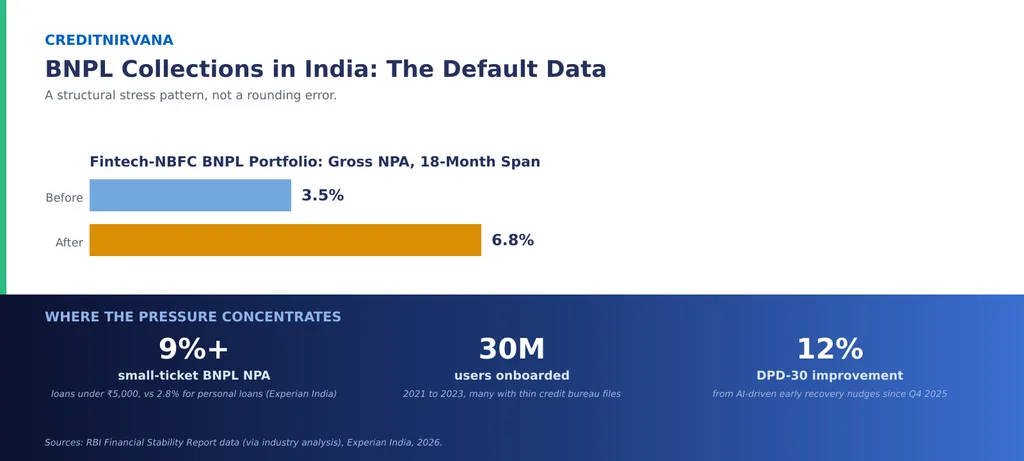
The scale of this shift is no longer small enough to defer. Fintech-NBFC BNPL portfolios saw gross NPA rise from 3.5 percent to 6.8 percent over an eighteen-month period, according to industry analysis of RBI’s Financial Stability Report data. Small-ticket BNPL loans under five thousand rupees are running NPA levels above 9 percent, more than three times the 2.8 percent seen in standard personal loans, per Experian India data. This is not a rounding error in an otherwise stable book. It is a structural stress pattern that BNPL collections in India will need to be built around, not layered on top of an unrelated existing process.
Why BNPL Defaults Differently
The roots of this stress trace back to how BNPL scaled in the first place. Between 2021 and 2023, Indian BNPL platforms onboarded roughly 30 million new users, a large share of them with thin or nonexistent credit bureau files. Thin-file underwriting inflated exposure precisely because the data needed to price risk accurately simply didn’t exist yet for many of these borrowers.
Regulation has since caught up in a way that changed the collections picture directly. RBI’s Digital Lending Directions, issued in May 2025, tightened oversight of the relationship between regulated entities and lending service providers, strengthened borrower protections, and imposed stricter standards on data handling and app governance. One consequence borrowers may not fully realise yet: a BNPL default no longer quietly disappears. It now follows the borrower into their formal credit history, a meaningful shift from the earlier era when BNPL often sat outside standard bureau reporting entirely.
The market has already started sorting itself along these lines. MobiKwik discontinued its BNPL offering in 2025 as tightening economics and stricter rules made the previous model unworkable. Meanwhile, platforms with disciplined collections infrastructure have shown what’s achievable: providers deploying AI-driven early recovery nudges reportedly improved 30-day-past-due metrics by around 12 percent since late 2025.
The Separate Problem Co-Lending Creates
Co-lending brings a different kind of complexity to BNPL collections in India, one rooted in structure rather than borrower risk profile. RBI’s co-lending framework requires both the originating bank and the partner NBFC to hold their respective portions of every loan on their own books. That single structural requirement creates a data consistency challenge that manual reconciliation cannot realistically solve at scale.
When two institutions’ loan management systems carry different records of the same loan’s outstanding balance, EMI schedule, or prepayment status, the downstream effects compound quickly. Audit trails break. Bureau reporting between the two partners diverges. Collections workflows can end up targeting the wrong amount entirely, chasing a balance that one system shows as overdue and the other has already reconciled. Every disbursement cycle that runs on shared spreadsheets instead of real system integration adds another layer of regulatory exposure on top of the underlying credit risk.
This is the part of BNPL collections in India that most conversations about the category miss entirely, because it has nothing to do with the borrower’s creditworthiness. Two institutions can each be individually diligent and still produce a collections failure, simply because their systems don’t agree on the current state of the loan. Fixing that requires a shared data layer, not stricter policy on either side alone.
What This Means for a Collections Strategy
BNPL collections in India cannot run on the same fixed-sequence playbook built for a twelve or twenty-four month personal loan. Three adjustments matter most.
Speed has to match tenure. A BNPL loan often has a repayment window measured in weeks, not years. A collections strategy that takes ten days to escalate an account has, in relative terms, already let a meaningful share of the loan’s entire lifecycle pass. Early-bucket response needs to be faster and more automated than a traditional collections calendar assumes.
Co-lending accounts need shared, reconciled data, not two partial views. A collections action based on one partner’s outdated balance is worse than no action at all, since it damages the borrower relationship without recovering anything and creates a compliance record that doesn’t match the other partner’s books. Real-time reconciliation between bank and NBFC systems has to sit underneath any collections workflow touching a co-lent account.
Thin-file borrowers need behavioral signal, not just bureau data. Many BNPL borrowers still have limited credit history, which means the propensity and risk signals available to a lender have to come substantially from the platform’s own transaction and repayment behaviour, not solely from an external bureau score that may not yet reflect this borrower’s real risk profile.
This is precisely the kind of environment CreditNirvana’s Digital Collection Automation and ML Collection Analytics Engine are built to handle: fast, multilingual, context-aware outreach across WhatsApp, SMS, and IVR for short-tenure accounts, combined with propensity scoring that draws on payment behaviour rather than bureau history alone. For co-lending specifically, a single collection strategy layer that sits above both partners’ loan management systems, rather than duplicating logic inside each one separately, is what keeps collections workflows targeting the actual current balance instead of a stale reconciliation.
What Good BNPL Collections Actually Looks Like in Practice
It’s worth being concrete about what separates effective BNPL collections in India from a strategy that’s simply reusing an older playbook on a newer product. The difference shows up in three specific behaviours, not in the technology stack alone.
A well-run BNPL collections process reaches out within hours of a missed payment, not days, because the entire loan tenure is often measured in weeks. It offers a genuinely proportionate response, a gentle reminder for a first miss, not the same escalation tone used for a borrower who has ignored five prior contacts. And it treats a co-lent account’s data as provisional until reconciled, flagging discrepancies between partner systems rather than acting on whichever number happens to be closer at hand.
None of this is complicated in isolation. What makes it hard is doing all three consistently, at volume, across a portfolio that is growing faster than most collections teams were originally staffed and built for.
BNPL collections in India will only become a larger share of total recovery volume from here, not a smaller one. The lenders treating it as a genuinely different discipline now, rather than an edge case their existing collections process will eventually absorb, are the ones who will avoid rebuilding this capability under pressure later.
Frequently Asked Questions
Why do BNPL loans default differently than traditional loans? BNPL loans typically have short repayment windows and were often underwritten with thin credit files, since many borrowers had limited bureau history when the loan was issued. This combination means default risk concentrates faster and earlier in the loan’s life than it does for a traditional, longer-tenure personal loan.
What is the current NPA rate for BNPL loans in India? Industry data citing RBI’s Financial Stability Report shows fintech-NBFC BNPL portfolio gross NPA rising from 3.5 percent to 6.8 percent over an eighteen-month period. Small-ticket BNPL loans under five thousand rupees have shown NPA levels above 9 percent, according to Experian India data, compared with 2.8 percent for standard personal loans.
Why is co-lending collections harder to manage than a standard loan? RBI’s co-lending framework requires both the bank and the NBFC partner to hold their respective portions of a loan on separate books. When the two institutions’ systems aren’t tightly integrated, records of outstanding balance and repayment status can diverge, leading to collections actions based on outdated or incorrect information.
Does a BNPL default affect a borrower’s credit score in India? Yes, and this is a relatively recent shift. Under RBI’s tightened Digital Lending Directions, BNPL defaults are now expected to be reported into the borrower’s formal credit history, unlike in BNPL’s earlier years, when many platforms operated largely outside standard bureau reporting.