

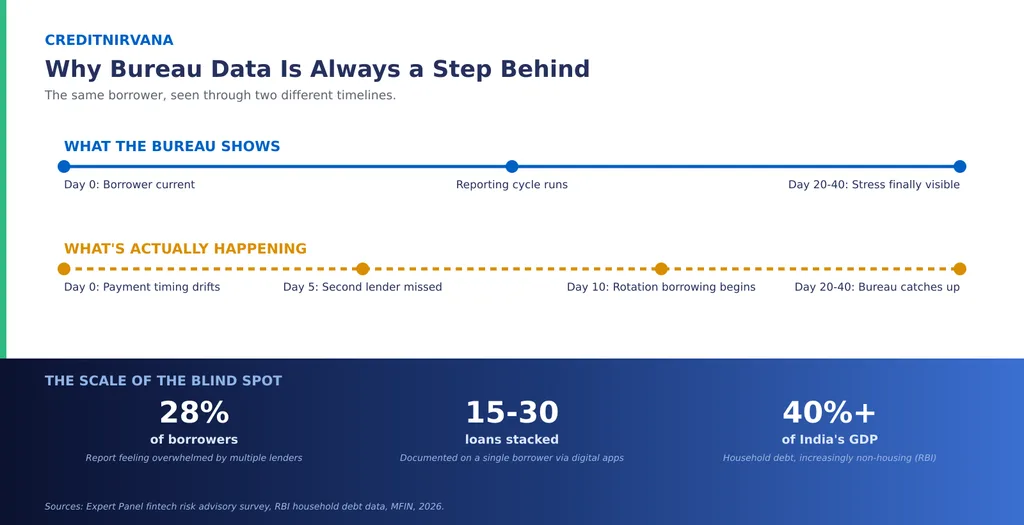
A borrower can be fully current on an EMI with your institution and still be six weeks from default. Not because anything has changed in their relationship with you, but because they are quietly carrying debt across three, five, sometimes fifteen other lenders, and the first place that stress shows up is never the loan you happen to be watching. By the time your bureau report reflects it, the borrower has often already missed payments elsewhere for weeks. This is not a hypothetical risk. It is a documented, growing pattern in Indian retail credit, and it is one that bureau data, on its own, is structurally late to catch.
How Serial Refinancing Actually Works
The mechanics here are worth understanding precisely, because the pattern is more deliberate than it first appears. Recent reporting has described digital lending apps stacking fifteen to thirty active loans onto a single borrower’s balance sheet, with platforms effectively trading cash flows among themselves. An over-leveraged borrower takes a new loan from one app specifically to service a payment due on another. Each individual lender sees a borrower who is, technically, still paying. What none of them sees in isolation is a borrower running an unsustainable rotation across their entire book of debt.
This is not a fringe phenomenon confined to unregulated apps. A survey by fintech risk advisory Expert Panel found that 28 percent of borrowers reported being overwhelmed by obligations to multiple lenders, and 39 percent reported experiencing abusive recovery calls, a strong signal that the multi-lender stress and the collections response to it are already colliding at scale. RBI’s own data shows household debt has now crossed 40 percent of India’s GDP, with the growth increasingly concentrated in non-housing, consumption-driven borrowing rather than asset creation. That combination, rising household leverage plus borrowing concentrated in short-tenure consumption credit, is exactly the environment where cross-lender stress accumulates fastest and shows up latest.
Why Bureau Data Lags Reality
Credit bureau reporting has genuinely improved in recent years, moving away from purely monthly cycles toward more frequent updates. But an improvement in frequency is not the same as real-time visibility, and the gap that remains is not trivial. A loan closed on the third of the month can still show as active in a bureau report pulled on the sixth, a lag that cuts both ways: it can make a borrower look riskier than they are, and it can just as easily hide genuine new stress that hasn’t been reported yet.
The more serious gap sits with products that don’t report cleanly into the mainstream bureau system at all. In the microfinance sector, the Microfinance Institutions Network, the industry’s self-regulatory body, has explicitly flagged that non-reporting of EMIs on certain retail loans and non-EMI products like gold loans creates real underwriting blind spots. MFIN’s own data shows roughly 15 percent of microfinance borrowers hold exposure to more than two lenders, and the organisation issued formal guidelines specifically to help lenders account for missing EMI data in their underwriting decisions, a direct acknowledgement that bureau data alone was not giving the full picture.
Put simply: bureau data tells a lender what has already been reported. It does not tell a lender what is happening right now, in the days or weeks before that reporting catches up.
The Cross-Product Warning CIBIL Already Flagged
There is a second, quieter version of this blind spot, and it doesn’t require an unregulated app or an unreported product to exist. TransUnion CIBIL’s own research identified that among the 37 million Indian borrowers holding both unsecured and secured loans, roughly 15 percent of all retail borrowers, delinquency in the unsecured loan reliably shows up before delinquency in the secured loan from the same borrower. In other words, the warning sign was already sitting inside the bureau’s own data. It simply required looking at a borrower’s full credit relationship, across products, rather than monitoring each loan in isolation.
This matters enormously for how a lender should actually use the data they already have access to. The blind spot is not always a data availability problem. Sometimes it is a data integration problem: the right signal exists, but it’s sitting in a different product silo than the one a collections team happens to be watching.
What Actually Catches This Before the Bureau Does
If bureau data is structurally lagging, the answer is not to wait for better bureau infrastructure. It is to build detection that doesn’t depend on bureau timing at all, and to draw on signal a lender already has direct access to, from its own relationship with the borrower.
Behavioral signal is available well before a bureau report would ever reflect stress. A borrower whose payment timing has started drifting later in the month, even by a few days, is showing an early pattern. A borrower whose responsiveness on previously reliable channels starts dropping, or whose sentiment in ordinary service conversations shifts, is signalling something before it becomes a missed EMI. A borrower who begins requesting smaller, more frequent draws, or who shows unusual urgency around repayment timing, is exhibiting exactly the kind of rotation behaviour that precedes cross-lender stress.
This is the specific gap CreditNirvana’s ML Collection Analytics Engine is built to close. A Bounce Predictor and Normax Predictor score every account’s propensity to miss its next payment using behavioral and payment-pattern signal, not bureau data alone, and an Early Warning System forecasts risk ahead of the due date rather than after a bureau cycle has caught up. Because this scoring runs continuously against the lender’s own transaction and interaction data, it can flag a borrower drifting into stress days or weeks before that stress would ever appear in an external report.
What a Lender Should Actually Do With This Signal
Catching the signal early only matters if what follows is useful, and it’s worth being direct about what “useful” means here. This is not about using early detection to escalate pressure on a borrower before anything has technically gone wrong. That approach would be both counterproductive and, given the direction current regulatory scrutiny is heading, increasingly risky in its own right.
The better use of an early signal is a supportive one: a proactive conversation about restructuring before default, a smaller and more manageable repayment plan offered ahead of the point where the borrower has already missed a payment elsewhere, or simply a check on affordability before extending further credit to a borrower already showing rotation behaviour. Caught early enough, cross-lender stress is often still resolvable without either party losing much. Caught only when a bureau report finally reflects it, the borrower is usually already in a genuinely difficult position, and the lender’s options have narrowed to considerably more expensive ones.
The Regulatory Angle: Why Reading This Signal Responsibly Matters
There is a version of early detection that makes this problem worse instead of better, and it is worth naming directly. Using behavioral signal to identify a borrower drifting toward cross-lender stress, and then responding with faster, harder collections pressure, treats a warning sign as an excuse to escalate. Given that 39 percent of surveyed borrowers already report experiencing abusive recovery calls, adding earlier detection on top of an aggressive collections posture would likely worsen exactly the outcome regulators are already scrutinising closely.
This also isn’t just a reputational risk. Behavioral data used for risk scoring, payment timing, communication patterns, sentiment in prior conversations, falls squarely within the kind of personal data the DPDP Act governs, and using it responsibly means being able to demonstrate that it is collected and processed for a legitimate, disclosed purpose, not repurposed quietly into a pressure tactic. A lender that cannot clearly explain why a particular signal triggered a particular action is building risk into its own compliance posture, on top of whatever credit risk it was trying to manage in the first place.
The commercial case and the compliance case point in the same direction here. Early detection used to offer support, a restructuring conversation, a smaller repayment plan, an affordability check before extending more credit, protects the lender’s recovery economics and the borrower’s ability to actually repay. Early detection used to escalate pressure sooner protects neither, and adds regulatory exposure on top.
Frequently Asked Questions
What is the multi-lender blind spot in Indian credit risk? It refers to the gap between a borrower’s real, total debt exposure across multiple lenders and what any single lender or credit bureau report can see at a given moment. Because bureau reporting has a lag and some products report inconsistently, a borrower can be accumulating unsustainable debt across several lenders before any single institution’s data reflects the risk.
How many Indian borrowers are affected by multi-lender exposure? Recent survey data puts the figure at roughly 28 percent of borrowers reporting they feel overwhelmed by obligations to multiple lenders, while MFIN data shows about 15 percent of microfinance borrowers specifically hold exposure to more than two lenders. Digital lending apps have been documented stacking as many as fifteen to thirty active loans on a single borrower.
Can credit bureau data alone catch over-leveraged borrowers in time? Not reliably. Bureau reporting has improved in frequency but still carries a lag of days to weeks, and certain products, like gold loans and some retail EMIs, have historically reported inconsistently into bureau systems. By the time bureau data reflects stress, the borrower is often already several weeks into it.
What can lenders use instead of, or alongside, bureau data to detect this risk earlier? Behavioral and payment-pattern signal from the lender’s own relationship with the borrower, changes in payment timing, communication responsiveness, and repayment request patterns, can surface stress before it appears in bureau data. Systems built for continuous early-warning scoring, rather than periodic bureau-based review, close most of this gap.